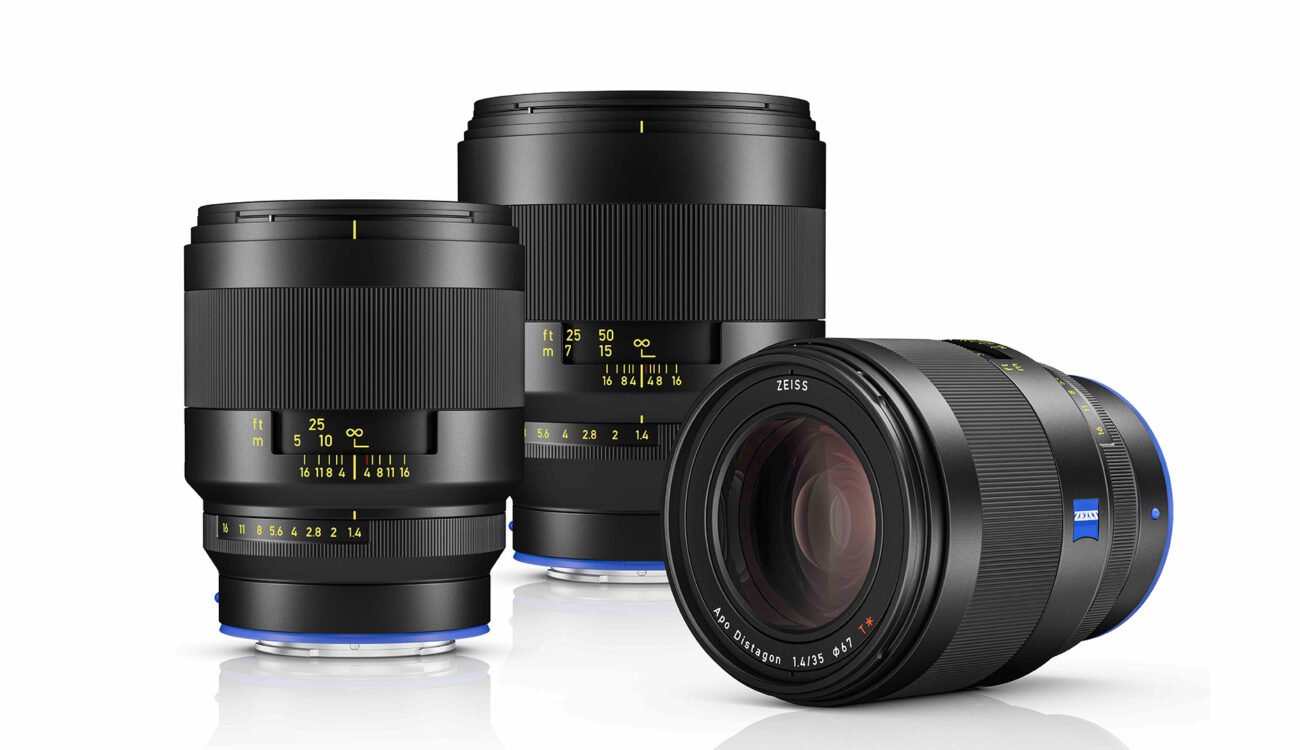
ZEISS has expanded its Otus ML lens family with the new Otus ML 1.4/35, a manual-focus 35mm f/1.4 prime for Sony E, Canon RF, and Nikon Z mount mirrorless cameras. Featuring 15 elements in 11 groups with an aspherical Distagon design, a 10-blade aperture, 257° focus throw, and de-clickable aperture ring, the lens completes the Otus ML trio alongside the existing 50mm and 85mm primes.
Otus ML 35mm f/1.4 Lens (Sony E)
all prices excluding sales tax/VAT
Almost exactly one year after unveiling the Otus ML 50mm f/1.4 and 85mm f/1.4, ZEISS is back with its third Otus ML prime. The new 35mm fills the wide-angle gap in the lineup and is aimed at street, travel, and documentary shooters who want ZEISS optical character without relying on adapters from the older DSLR-era Otus range. For filmmakers, the de-clickable aperture and generous focus rotation make this an interesting proposition as well, particularly when paired with ZEISS Lens Gears for a proper cine-style setup.

ZEISS Otus ML 1.4/35. Image credit: ZEISS
Optical design and image quality
The ZEISS Otus ML 1.4/35 uses an aspherical Distagon optical formula, arranging 15 elements across 11 groups. That construction includes two aspherical elements and seven anomalous partial dispersion glass elements, which ZEISS says work together to minimize distortion and chromatic aberrations across the entire focusing range. The ZEISS T* anti-reflective coating is applied to reduce flare and ghosting, maintaining contrast and color fidelity even in challenging backlit or high-contrast lighting conditions.
ZEISS continues to market the Otus ML series around its signature “3D Pop,” the combination of natural color rendition, high micro-contrast, and edge-to-edge sharpness that gives images an almost three-dimensional quality. A 10-blade aperture shapes the bokeh into smooth, rounded transitions, while the f/1.4 maximum aperture provides considerable subject separation even at 35mm. The minimum focus distance sits at 0.30m / 11.81in (free working distance), yielding a maximum magnification ratio of 1:5.7.
Lenses are one of the most important creative tools in cinematography. Learn the foundations of optics and gain the ability to design lens tests, collaborate with technicians and understand technical specifications.
Build quality and mechanical precision
Like its siblings, the Otus ML 1.4/35 features full-metal construction with clearly marked yellow distance and depth-of-field scales. The helicoid-driven focus ring provides a 257° rotation angle, which is nearly identical to the 259.5° on the 50mm and notably more generous than the 244° on the 85mm. This long throw is designed for millimeter-accurate manual focusing, and the fully mechanical (not focus-by-wire) linkage means each focus distance maps consistently to a specific rotational position on the ring.
The lens also includes an aperture de-click function, switchable with a small supplied tool. When de-clicked, the aperture ring allows seamless, silent transitions, a practical feature for video work where stepped iris changes would be visible. For filmmakers looking for even more cine functionality, Duclos Lenses already offers a Cine-Mod for the Otus ML series, adding a 32-pitch focus gear and unified 95mm front diameter across the range.

ZEISS Otus ML 1.4/35 used for street photography. Image credit: ZEISS
What about video use?
The Otus ML series is primarily positioned as a photography lens, but ZEISS has clearly designed it with dual-use in mind. The de-clickable aperture, long focus throw, and internal focusing (which keeps the lens length constant during focus pulls) are all features filmmakers will appreciate. Combined with ZEISS Lens Gears, the Otus ML lenses can function as proper cine-style primes on gimbal, rig, or tripod setups.
Each mount variant includes electronic contacts that communicate with the camera body, enabling EXIF data recording and various camera-assist functions. That said, these remain fully manual-focus, manual-aperture lenses at heart. There is no autofocus, and the aperture is controlled entirely from the lens ring. For shooters who embrace that deliberate, hands-on approach, this is a feature rather than a limitation.
Dimensions, weight, and what is included
Physical dimensions vary slightly by mount. The lens has a maximum diameter of 77mm / 3.0in across all versions, with length ranging from approximately 101mm / 4.0in for the Sony E-mount version to around 116mm / 4.6in for the Canon RF version. Weight ranges from 698g / 24.6oz (Sony E) to 717g / 25.3oz (Canon RF) and 737g / 26.0oz (Nikon Z). Filter thread diameter is 67mm.
Each lens ships with a reversible metal petal-shaped lens hood and a cushioned ZEISS-branded lens pouch. The de-click tool is also included in the box.
Shot taken with the ZEISS Otus ML 1.4/35. Image credit: ZEISS
The Otus ML trio is now complete
With the 35mm joining the already-shipping 50mm and 85mm, ZEISS now offers a cohesive three-lens set of fast manual-focus primes for mirrorless systems. The 50mm ($2,499) serves as a versatile general-purpose prime, the 85mm ($2,999) handles portrait and telephoto work, and the new 35mm ($2,299) covers wide-angle storytelling, environmental portraiture, and documentary applications.
All three share the same design language, full-metal build, 10-blade aperture, and de-clickable iris. The consistent mechanical feel across the set makes switching between focal lengths intuitive, which is a real advantage on fast-paced shoots where muscle memory matters.
Pricing and availability
The ZEISS Otus ML 1.4/35 will be available from specialty retailers in spring 2026 at $2,299 (excluding tax) / €2,399 (including 19% German VAT). All three mount versions (Sony E, Canon RF, Nikon Z) are expected to ship simultaneously. For more information and full specifications, visit zeiss.com/otus-ml.
At $2,299, the Otus ML 1.4/35 is the most affordable lens in the trio, though it still sits firmly in premium territory. We are curious to see how the optical performance holds up against competing 35mm primes once we can get it into the lab. Are you still shooting manual-focus lenses in your work, and does a 35mm complete this set for you? Let us know in the comments below!